
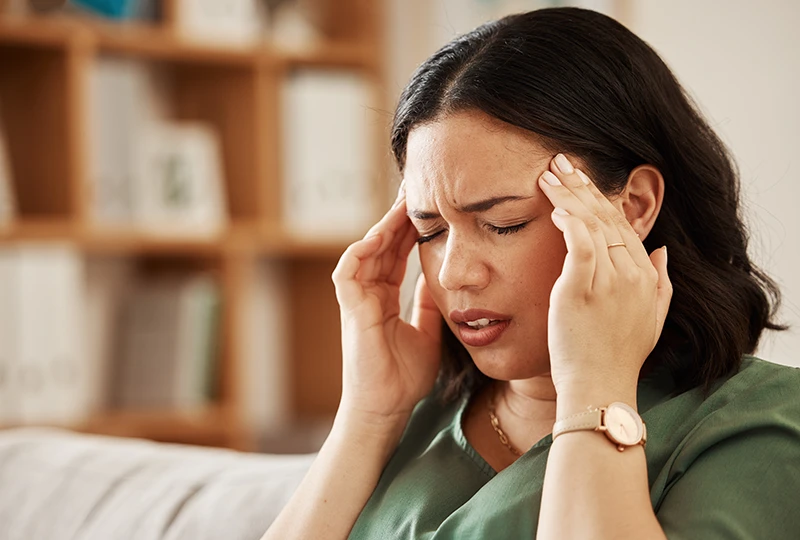
You finish a long day of emails, reading, or screen time and notice it again—that dull pressure behind your eyes or a headache that feels a lot like a migraine. You might think the cause is stress, not getting enough sleep, or something you ate or drank, but what if there’s something else going on?
Many people have what feels like migraines, but it is actually related to a common but often overlooked eye problem known as binocular vision dysfunction. Even with 20/20 vision, the eyes don’t always coordinate perfectly, and that can lead to migraine-like discomfort.
When your eyes are working harder than you realize
Binocular vision dysfunction (BVD) happens when the eyes don’t coordinate as smoothly as they should. Each eye may see clearly on its own, but the brain has to work harder to combine the two images into one.
That extra effort can build throughout the day, especially during tasks that require steady focus.
If BVD is causing your headaches, you might also notice other symptoms like:
- Eyes feeling tired or strained earlier in the day
- Trouble switching focus between near and far
- Feeling “off” after driving or being in visually busy spaces
- Light sensitivity that comes and goes
These symptoms often feel unrelated at first, which is why many people don’t connect them to their vision.
Why a normal eye exam doesn’t always tell the full story
It can be confusing to hear your prescription is fine, especially when you still feel uncomfortable. A standard vision test focuses on clarity, but not always on how well your eyes work together.
Even if you don’t need to wear glasses or contact lenses, eye coordination issues can still contribute to discomfort throughout the day. That’s where a deeper look during a comprehensive eye exam becomes helpful.
This type of exam can uncover issues like:
- Eye teaming problems
- Focusing delays between tasks
- Misalignment between the eyes
- Strain that builds during close work
How Neurolens may relieve daily eye strain
When symptoms like headaches, eye fatigue, and pressure behind the eyes keep returning, Neurolens can help address the underlying misalignment that may be causing discomfort.
Unlike standard glasses or contact lenses, Neurolens uses contoured prism technology to help bring the eyes into better alignment. By reducing the strain between the eyes and brain, it can ease the constant visual stress that tends to build throughout the day.
Many patients consider Neurolens after noticing:
- Headaches that always seem tied to screens or reading
- Eyes that feel tired way too quickly
- Difficulty staying focused on tasks they used to handle easily
- A sense that visual work is physically draining
For some, it’s not just about seeing clearly—it’s about not feeling exhausted by the end of the day.
Finding relief beyond the “it’s just a headache” explanation
Imagine not having to rely on painkillers or visit doctor after doctor looking for migraine relief. For some people, that kind of change is possible with Neurolens, especially when the root cause is tied to how the eyes are working together.
If migraine-like symptoms keep coming back, schedule a comprehensive eye exam at Overland Optical Family Eye Care in St. Louis or St. Charles to find real relief.